The Stones of Venice - John Ruskin
The Stones of Venice is een meesterlijke studie over de architectuur van Venetië waarin John Ruskin betoogt dat de gotische bouwstijl de morele en spirituele gezondheid van een samenleving weerspiegelt. Het boek is wereldberoemd vanwege de felle kritiek op de zielloze industriële massaproductie en de enorme invloed die het hiermee uitoefende op de Arts and Crafts-beweging. De combinatie van diepgaande kunsthistorische analyse en gepassioneerde maatschappijkritiek maakt het tot een tijdloze klassieker over de menselijke waarde van vakmanschap.
Bestel dit boek bij bol.com
alle citaten van John Ruskin


Citaten 1 t/m 5 van 5.
-
De taak der wetenschap is, feiten voor schijn en bewijzen voor indrukken in de plaats te stellen.
Origineel:The work of science is to substitute facts for appearances, and demonstrations for impressions.
The Stones of Venice (1853) Vol. III― John Ruskin -
Wie de waarheid in het hart heeft, hoeft nooit te vrezen dat zijn tong te weinig overtuigingskracht zal hebben.
Origineel:He who has truth at his heart need never fear the want of persuasion on his tongue.
The Stones of Venice (1853) I. The Foundations, §xcix― John Ruskin -
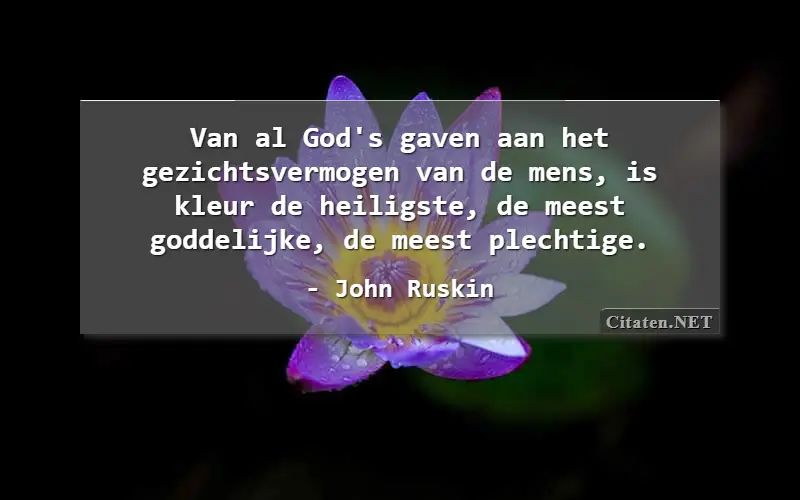
Van al God's gaven aan het gezichtsvermogen van de mens, is kleur de heiligste, de meest goddelijke, de meest plechtige.
Origineel:Of all God's gifts to the sight of man, colour is the holiest, the most divine, the most solemn.
The Stones of Venice (1853) Vol II, Ch. V, §30― John Ruskin -
Vergeet niet dat de mooiste dingen op aarde de meest nutteloze zijn: pauwen en lelies bijvoorbeeld.
Origineel:Remember that the most beautiful things in the world are the most useless: peacocks and lilies, for instance.
The Stones of Venice (1853) Vol I, ch. II, §17― John Ruskin -
De meest pure en weldoordachte mensen zijn zij die het meest van kleur houden.
Origineel:The purest and most thoughtful minds are those which love colour the most.
The Stones of Venice (1853) Vol 2, Ch. V, §30― John Ruskin
De beste The Stones of Venice van John Ruskin citaten, wijsheden, quotes en uitspraken vindt u nu al ruim 25 jaar op citaten.net.