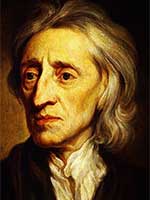
John Locke
Engels filosoof
Leefde van: 1632 - 1704
Categorie: Filosofen Land:  Verenigd Koninkrijk
Geboren: 29 augustus 1632 Gestorven: 28 oktober 1704
Over John Locke
John Locke (Wrington bij Bristol, 29 augustus 1632 – High Laver, Essex, 28 oktober 1704) was een Engels filosoof, econoom en arts in de periode van de vroege Verlichting.
Locke maakte in zijn opvattingen over het ongeschreven natuurrecht als grondslag van het formele staatsrecht het sociaal contract de basis van zijn pleidooi voor volkssoevereiniteit, de gedachte dat de vorst of de regering de wil van het volk moet weerspiegelen.
Toen Locke het werk van Descartes las, zag hij de grote Franse filosoof als een levensvatbaar alternatief voor het aristotelinisme dat hij in Oxford had geleerd. In zijn werk An Essay Concerning Human Understanding neemt hij deze ideeën zo over dat ze een onderdeel van zijn ideeën en denken worden.
Locke kende het rationalisme goed, maar vond dat de rede alleen te beperkt was om als fundament voor kennis te dienen. Daartoe was ook de ervaring en de reflectie daarop nodig: ervaringskennis zoals die opgedaan werd door lieden als Robert Boyle, Thomas Sydenham, Christiaan Huygens en Isaac Newton.
In zijn tijd werd er geloof gehecht aan het bestaan van aangeboren kennis ("innate knowledge"), een opvatting die door Locke werd verworpen.
Naast onder anderen Thomas Hobbes, Spinoza, Montesquieu, Rousseau en (meer recent) Rawls heeft Locke ook naam als een van de grote verdragstheoretici. Verdragstheorieën (vaak "sociaal contract" genoemd) geven een onderbouwing, en daarmede een rechtvaardiging van de staat en de staatsmacht. Hierbij zijn vooral twee werken van belang: Two Treatises of Government (1689) en Epistulae de tolerantia (brieven over verdraagzaamheid, 1689-1706).
Bron Wikipedia
Boeken van John Locke
Bestel John Locke boeken bij bol.com:
 John Locke - An Essay Concerning Human Understanding Second Treatise of Goverment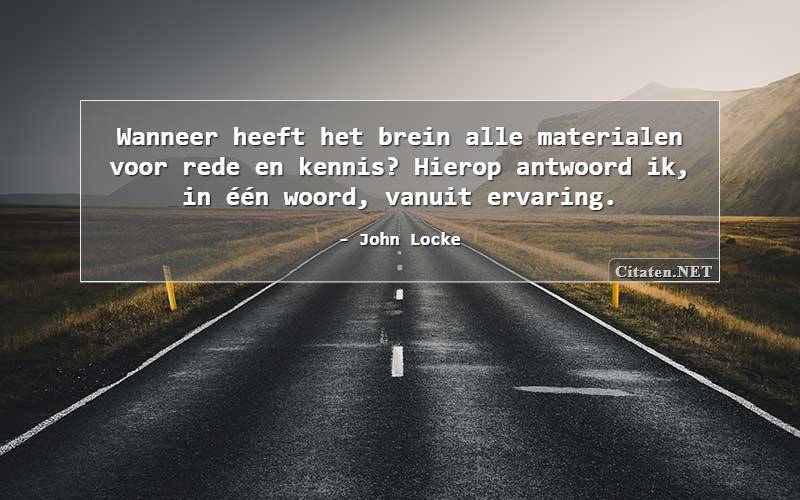







Zoek binnen de citaten van John Locke naar deze woorden:
Citaten 1 t/m 25 van 27.
-
Wanneer heeft het brein alle materialen voor rede en kennis? Hierop antwoord ik, in één woord, vanuit ervaring.
Origineel:Whence has it [the mind] all the materials of reason and knowledge? To this I answer, in one word, From experience.
Essay Concerning Human Understanding (1689) Book II/Chapter I, 2― John Locke -
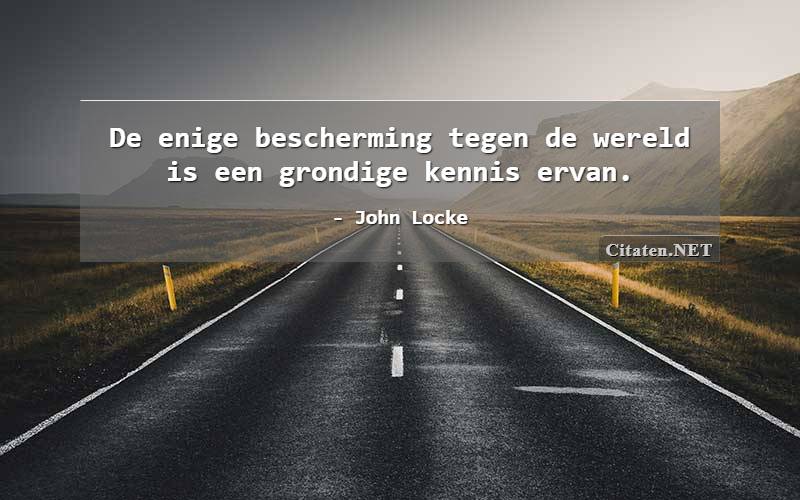
De enige bescherming tegen de wereld is een grondige kennis ervan.
Origineel:The only fence against the world is a thorough knowledge of it.
Some Thoughts Concerning Education (1693) Sec. 94― John Locke -
Nieuwe meningen worden altijd met argwaan bejegend, en stuiten gewoonlijk op verzet, om geen andere reden dan dat ze nog niet gebruikelijk zijn.
Origineel:New opinions are always suspected, and usually opposed, without any other reason but because they are not already common.
Essay Concerning Human Understanding (1689) Epistle Dedicatory― John Locke -
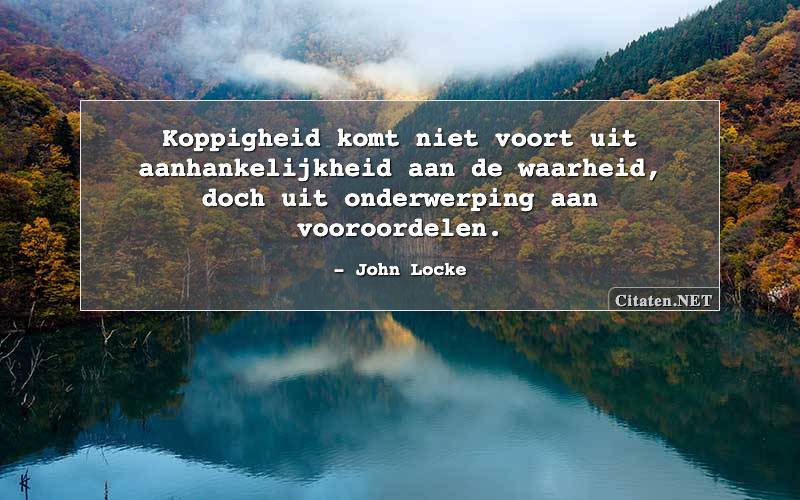
Koppigheid komt niet voort uit aanhankelijkheid aan de waarheid, doch uit onderwerping aan vooroordelen.
Origineel:Stiffness of the mind comes not from adherence to truth but from submission to prejudice.
Essay Concerning Human Understanding (1689) § 26― John Locke -
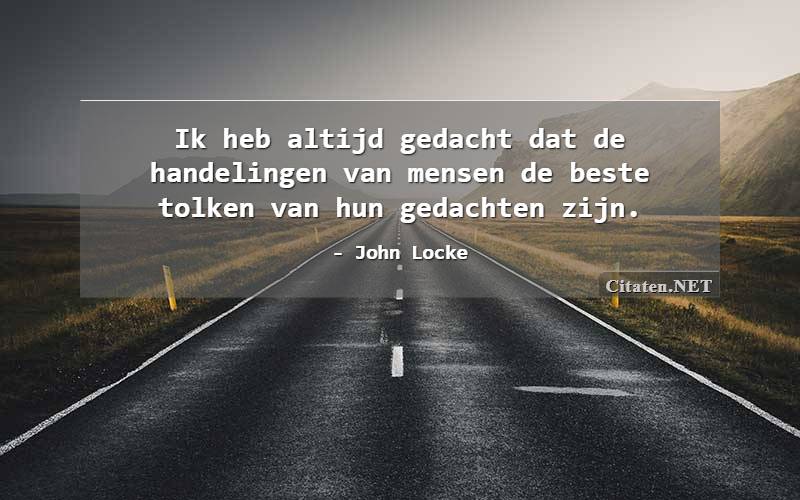
Ik heb altijd gedacht dat de handelingen van mensen de beste tolken van hun gedachten zijn.
Origineel:I have always thought the actions of men the best interpreters of their thoughts.
Essay Concerning Human Understanding (1689) Bk 1, Ch.3, sec.3― John Locke -
Een gezonde geest in een gezond lichaam is een korte doch volledige beschrijving van een gelukkige toestand in deze wereld.
Origineel:A sound mind in a sound body, is a short, but full description of a happy state in this world.
Some Thoughts Concerning Education (1693) Ch.1― John Locke -
Wij kunnen onder de mensen een grote diversiteit aan opinies over morele regels aantreffen, al naar gelang de verschillende soorten geluk waarop zij vooruitzicht hebben of voor zichzelf voorstellen. Dat zou niet het geval zijn als praktische principes aangeboren waren en rechtstreeks door de hand van God in onze geest gegrift.
Origineel:Hence naturally flows the great variety of opinions concerning moral rules which are to be found among men, according to the different sorts of happiness they have a prospect of, or propose to themselves; which could not be if practical principles were innate, and imprinted in our minds immediately by the hand of God.
Essay Concerning Human Understanding (1689) Bk 1, ch. 2, sec.6― John Locke -
Lezen voorziet de geest alleen van kennismateriaal; het is door ons denken dat we ons eigen maken wat we lezen.
Origineel:Reading furnishes the mind only with materials of knowledge; it is thinking that makes what we read ours.
Of the Conduct of the Understanding (1706) § 20― John Locke -
Er valt denk ik meestal meer te leren van de onverwachte vragen van een kind dan van de conversaties van volwassenen, die een pad bewandelen dat geplaveid is met de opvattingen die ze hebben overgenomen en met de vooroordelen die ze uit hun opvoeding hebben verkregen.
Origineel:And I think there is frequently more to be learn'd from the unexpected questions of a child than the discourses of men, who talk in a road, according to the notions they have borrowed, and the prejudices of their education.
Some Thoughts Concerning Education (1693) Sec. 121― John Locke -
Wij zijn absoluut onbekwaam tot universele en zekere kennis.
Origineel:We are utterly incapable of universal and certain knowledge.
Essay Concerning Human Understanding (1689) Bk. IV, ch.3, sec.28― John Locke -
Arbeid ter wille van de arbeid is tegennatuurlijk.
Origineel:Labour for labour-sake is against nature.
Of the Conduct of the Understanding (1706) § 16― John Locke -
Ouders vragen zich af waarom het water bitter is, terwijl ze zelf de bron vergiftigd hebben.
Origineel:Parents wonder why the streams are bitter, when they themselves have poisoned the fountain.
toegeschreven, ten onrechte― John Locke -
Het doel van wetten is niet om af te schaffen of te beperken, maar om vrijheid te behouden en te vergroten.
Origineel:The end of law is not to abolish or restrain, but to preserve and enlarge freedom.
Second Treatise of Government (1689) VI, sec. 57― John Locke -
Er is maar één ding dat mensen in een opruiende commotie brengt, en dat is onderdrukking.
Origineel:There is only one thing which gathers people into seditious commotion, and that is oppression.
― John Locke -
Het is veel gemakkelijker voor een leraar om bevelen te geven dan les te geven.
Origineel:It is easier for a tutor to command than to teach.
Some Thoughts Concerning Education (1693) § 64― John Locke -
De overheid heeft geen ander doel dan de bescherming van eigendom.
Origineel:Government has no other end than the preservation of property.
Second Treatise of Government (1689) Ch. VII. sec. 94.
Voor de volledige tekst zie: press-pubs.uchicago.edu― John Locke -
Het is de eerste stap om iemand te laten zien dat hij het fout heeft, en een andere om hem in het bezit van de waarheid te stellen.
Origineel:It is one thing to show a man that he is in error, and another to put him in possession of the truth.
Essay Concerning Human Understanding (1689) Book IV, Ch. 7, sec. 11― John Locke -
Ieder mens heeft het bezit over zijn eigen persoon. Niemand anders heeft hier recht op, alleen hijzelf.
Origineel:Every man has a property in his own person: this no body has any right to but himself.
Second Treatise of Government (1689) Of Property― John Locke -
Van niemand kan de kennis zijn ervaring overstijgen.
Origineel:No man's knowledge here can go beyond his experience.
Essay Concerning Human Understanding (1689) Book II, Ch. 1, sec. 19― John Locke -
Bij kinderen moet nieuwsgierigheid even zorgvuldig worden gekoesterd als andere begeertes onderdrukt moeten worden.
Origineel:Curiosity should be as carefully cherish'd in children, as other appetites suppress'd.
Some Thoughts Concerning Education (1693) Sec. 108― John Locke -
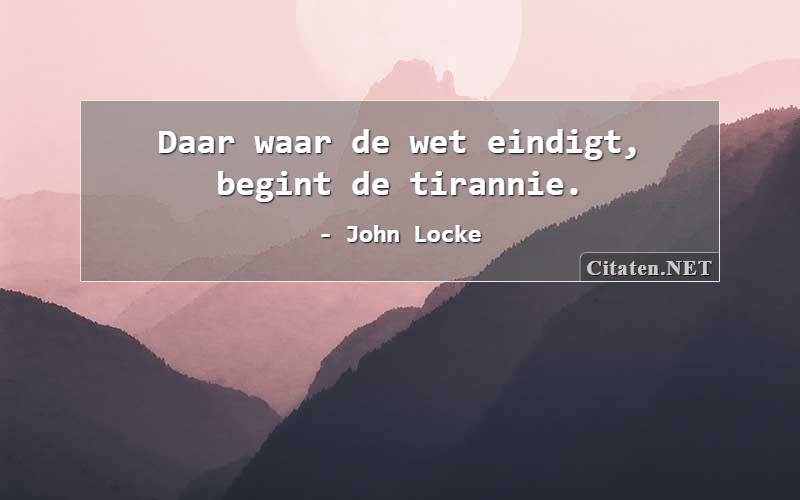
Daar waar de wet eindigt, begint de tirannie.
Origineel:Wherever Law ends, Tyranny begins.
Second Treatise of Government (1689) Sec. 202― John Locke -
Deugd is moeilijker te verkrijgen dan kennis van de wereld.
Origineel:Virtue is harder to be got than knowledge of the world.
Some Thoughts Concerning Education (1693) Sec. 70― John Locke -
Een drogreden dient alleen om mensen verwaander te maken in hun onwetendheid.
Origineel:Sophistry is only fit to make men more conceited in their ignorance.
In: John Lough (ed.) - Locke's Travels in France 1675-1679 Journal entry (25 January 1676)― John Locke -
Goed en kwaad, beloning en straf, dat zijn de enige redenen voor een rationeel wezen: zij zijn de sporen en teugels waar de hele mensheid door aan het werk wordt gezet en door wordt geleid.
Origineel:Good and evil, reward and punishment, are the only motives to a rational creature: these are the spur and reins whereby all mankind are set on work, and guided.
Second Treatise of Government (1689) Sec. 54― John Locke -
Mode is voor het grootste deel niets anders dan het uiterlijk vertoon van rijkdom.
Origineel:Fashion for the most part is nothing but the ostentation of riches.
― John Locke
Trefwoorden in deze citaten:
Vergelijkbare auteurs
-
 Francis Bacon
Engels filosoof en staatsman 110 -
Bertrand Russell
Engels filosoof, wiskundige en Nobelprijswinnaar literatuur (1950) 96 -
Alfred N. Whitehead
Engels filosoof en wiskundige 23 -
George Henry Lewes
Engels filosoof en criticus 6 -
Alan Watts
Engels filosoof, priester en schrijver 6 -
Jeremy Bentham
Engels filosoof en jurist 5 -
Robin George Collingwood
Engels filosoof en historicus 4 -
Oliver S. Braston
Engels filosoof 1
 Francis Bacon
 Bertrand Russell
 Alfred N. Whitehead
 Alan Watts
 Jeremy Bentham
 Robin George Collingwood