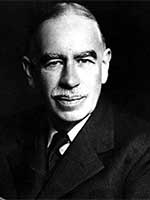
John Maynard Keynes
Brits econoom
Leefde van: 1883 - 1946
Categorie: Economie en ondernemers Land:  Verenigd Koninkrijk
Geboren: 5 juni 1883 Gestorven: 21 april 1946
Over John Maynard Keynes
John Maynard Keynes (Cambridge, 5 juni 1883 – Firle, East Sussex, 21 april 1946) was een Brits econoom.
Hij is vooral bekend geworden door het in 1936 verschenen boek The General Theory of Employment, Interest and Money, waarmee hij de grondlegger zou worden van de naar hem vernoemde keynesiaanse economie. Deze theorie was de grondslag van de macro-economie en indirect van het economisch beleid in de meeste westerse landen. Vanaf de jaren zeventig boette zijn werk aan populariteit in. Onder invloed van de in 2007 ontstane kredietcrisis leefde de belangstelling voor zijn werk aan het begin van de 21e eeuw weer op.
Keynes vergaarde in de jaren twintig een groot vermogen dankzij slimme beleggingen in buitenlandse valuta. Als gevolg van de beurskrach van 1929, die hij niet had voorzien, ging hij vrijwel failliet; alleen door steun van zijn vader en van vrienden wist hij financieel overeind te blijven. Spoedig wist hij zijn verliezen weer terug te verdienen.
Keynes' ideeën worden nog steeds onderwezen en hebben het economische denken drastisch veranderd. Zijn theorie is nog steeds terug te vinden in de meeste schoolboeken.
Bron Wikipedia
Boeken van John Maynard Keynes

Citaten 1 t/m 30 van 31.
-
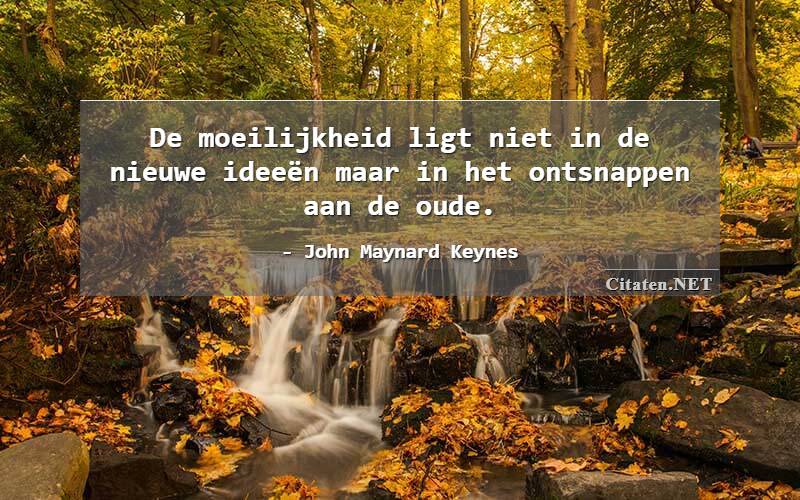
De moeilijkheid ligt niet in de nieuwe ideeën maar in het ontsnappen aan de oude.
Origineel:The difficulty lies, not in the new ideas, but in escaping from the old ones.
The General Theory of Employment, Interest and Money (1936) Preface― John Maynard Keynes -
Als je de bank 100 pond schuldig bent, heb jij een probleem. Maar als je de bank een miljoen pond schuldig bent, hebben zij een probleem.
Origineel:If you owe your bank a hundred pounds, you have a problem. But if you owe a million, it has.
toegeschreven.
Voor de volledige tekst zie: quoteinvestigator.com― John Maynard Keynes -
Als mijn informatie verandert, verander ik mijn conclusies. Wat doet u, meneer?
Origineel:When my information changes, I alter my conclusions. What do you do, sir?
The Economist (1983) Vol. 287, p. 19― John Maynard Keynes -
De plicht tot 'sparen' ging negentiende van deugdzaamheid uitmaken en het groter maken van de taart werd het doel van ware religie.
Origineel:The duty of "saving" became nine-tenths of virtue and the growth of the cake the object of true religion.
The Economic Consequences of the Peace (1919) Chapter II, Section III― John Maynard Keynes -
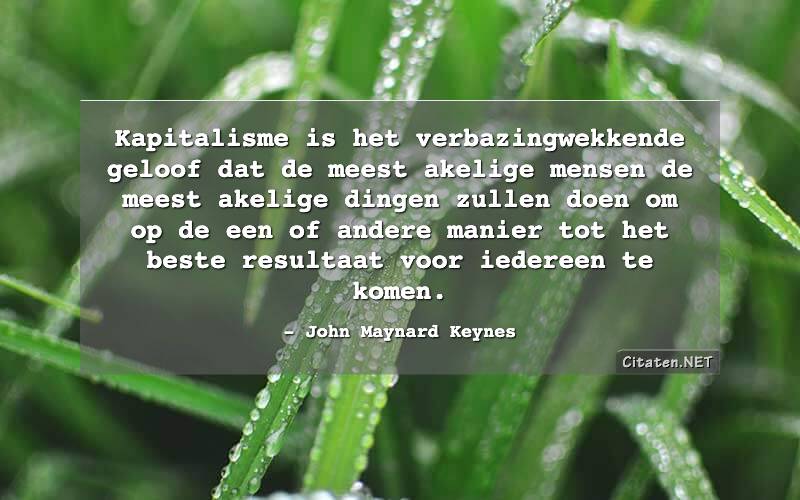
Kapitalisme is het verbazingwekkende geloof dat de meest akelige mensen de meest akelige dingen zullen doen om op de een of andere manier tot het beste resultaat voor iedereen te komen.
Origineel:Capitalism is the astonishing belief that the nastiest motives of the nastiest men somehow or other work for the best results in the best of all possible worlds.
― John Maynard Keynes -
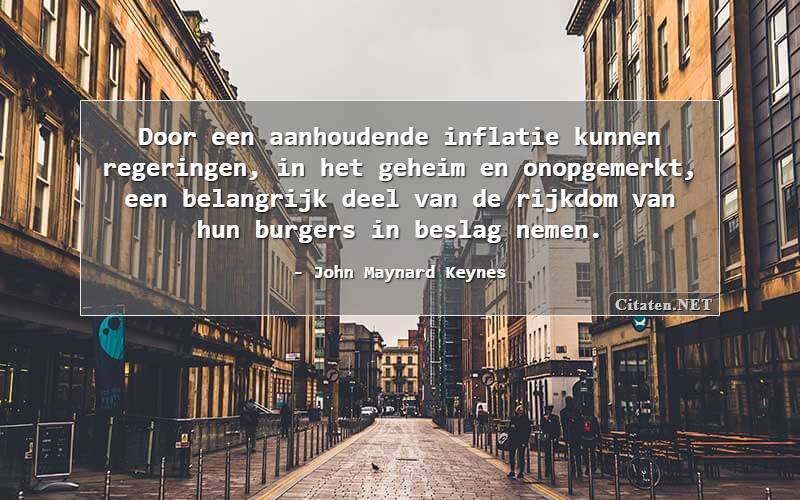
Door een aanhoudende inflatie kunnen regeringen, in het geheim en onopgemerkt, een belangrijk deel van de rijkdom van hun burgers in beslag nemen.
Origineel:By a continuing process of inflation, governments can confiscate, secretly and unobserved, an important part of the wealth of their citizens.
The Economic Consequences of the Peace (1919) ch. VI― John Maynard Keynes -
Ik weet niet wat een mens conservatiever maakt - niets anders dan het heden kennen, of niets anders dan het verleden kennen.
Origineel:I do not know which makes a man more conservative - to know nothing but the present, or nothing but the past.
― John Maynard Keynes -
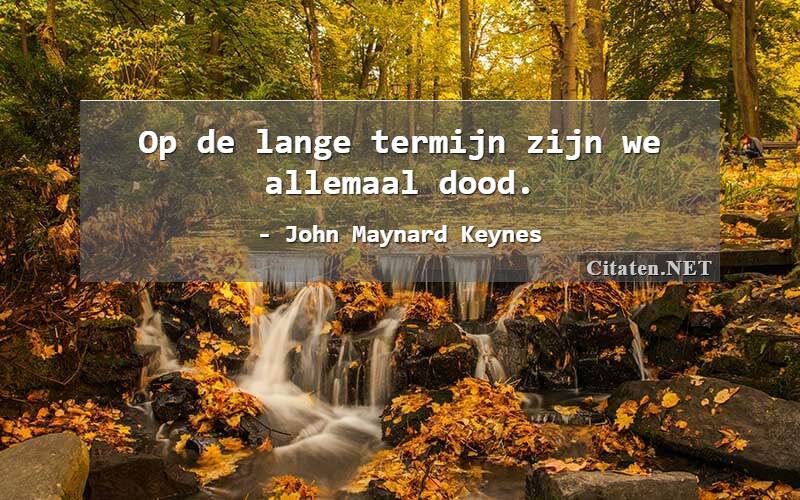
Op de lange termijn zijn we allemaal dood.
Origineel:In the long run we are all dead.
A Tract on Monetary Reform (1923) Ch.3― John Maynard Keynes -
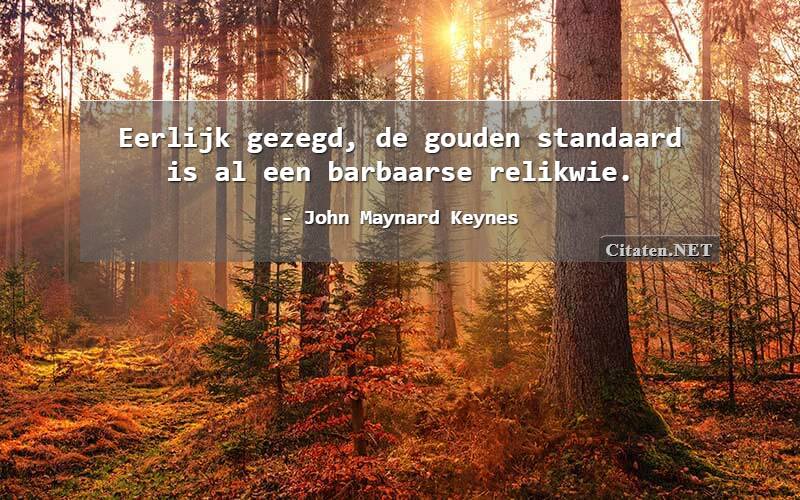
Eerlijk gezegd, de gouden standaard is al een barbaarse relikwie.
Origineel:In truth, the gold standard is already a barbarous relic.
A Tract on Monetary Reform (1923) p. 172― John Maynard Keynes -
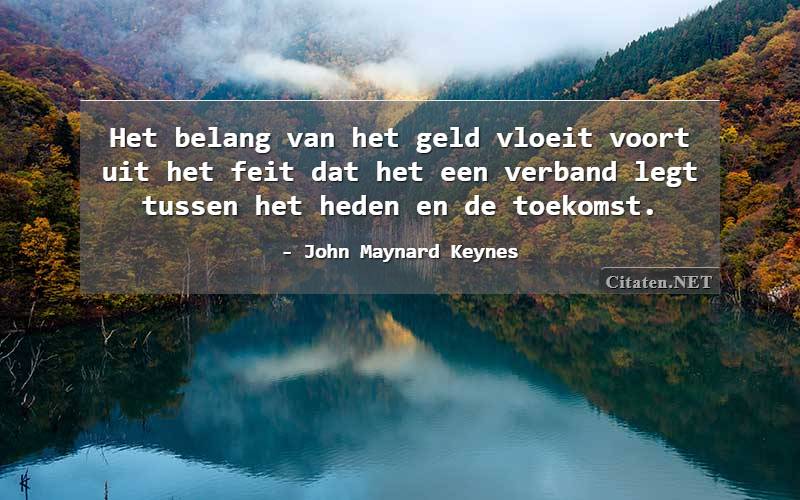
Het belang van het geld vloeit voort uit het feit dat het een verband legt tussen het heden en de toekomst.
Origineel:For the importance of money essentially flows from its being a link between the present and the future.
The General Theory of Employment, Interest and Money (1936) The Theory of Prices, p. 268― John Maynard Keynes -
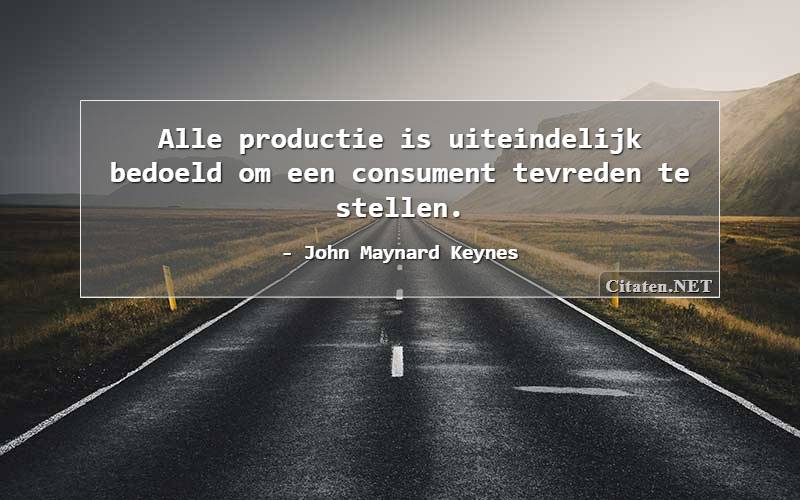
Alle productie is uiteindelijk bedoeld om een consument tevreden te stellen.
Origineel:All production is for the purpose of ultimately satisfying a consumer.
The General Theory of Employment, Interest and Money (1936) Bk 2, ch.5, sec. 1― John Maynard Keynes -
Als economen erin zouden slagen zichzelf te beschouwen als nederige, vaardige mensen op een vergelijkbaar niveau als tandartsen, dan zou dat geweldig zijn.
Origineel:If economists could manage to get themselves thought of as humble, competent people on a level with dentists, that would be splendid.
The Nation and Athenæum (1926) Economic Possibilities for our Grandchildren― John Maynard Keynes -
Als we doelbewust mikken op de verarming van Midden-Europa, zal de wraak, zo ik durf te voorspellen, niet ver achterblijven.
Origineel:If we aim deliberately at the impoverishment of Central Europe, vengeance, I dare predict, will not limp.
The Economic Consequences of the Peace (1919) ch. VII, sec. 1― John Maynard Keynes -
Het politieke probleem van de mensheid is om drie dingen te combineren: economische efficiëntie, sociale rechtvaardigheid en individuele vrijheid.
Origineel:The political problem of mankind is to combine three things: economic efficiency, social justice and individual liberty.
The Nation and Athenæum (1926) Liberalism and Labour.
Voor de volledige tekst zie: www.economicsnetwork.ac.uk― John Maynard Keynes -
Amerika mag niet de kans krijgen om de ogen uit te pikken van het Britse Rijk.
Origineel:America must not be allowed to pick out the eyes of the British Empire.
― John Maynard Keynes -
De meeste mensen houden, naarmate ze ouder worden, meer van geld en zekerheid, en minder van creatie en constructie.
Origineel:Most men love money and security more, and creation and construction less, as they get older.
The Nation and Athenæum (1926) Clissold― John Maynard Keynes -
Economie is een zeer gevaarlijke wetenschap.
Origineel:Economics is a very dangerous science.
Essays In Biography (1933) Robert Malthus― John Maynard Keynes -
Engeland staat nog steeds buiten Europa. Europa's stemloze trillingen bereiken haar niet. Europa is ver weg en Engeland maakt geen deel uit van haar lijf en leden.
Origineel:England still stands outside Europe. Europe's voiceless tremors do not reach her. Europe is apart and England is not of her flesh and body.
The Economic Consequences of the Peace (1919) p.2― John Maynard Keynes -
Hardnekkigheid kan enkel een straf en geen beloning opleveren.
Origineel:Obstinacy can bring only a penalty and no reward.
The General Theory of Employment, Interest and Money (1936) Bk 3, ch 9, sec 2― John Maynard Keynes -
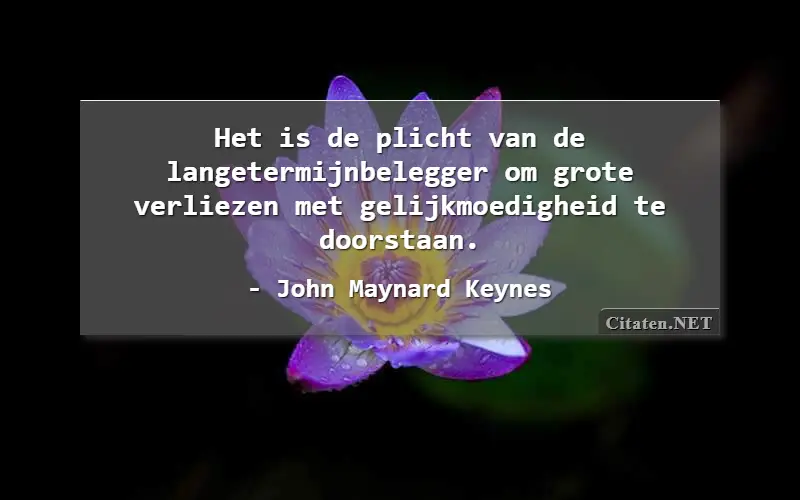
Het is de plicht van de langetermijnbelegger om grote verliezen met gelijkmoedigheid te doorstaan.
Origineel:It is the duty of the long-term investor to endure great losses with equanimity.
toegeschreven― John Maynard Keynes -
Het kan geen kwaad om soms ongelijk te hebben, vooral niet als men snel gecorrigeerd wordt.
Origineel:There is no harm in being sometimes wrong — especially if one is promptly found out.
Essays In Biography (1933) Alfred Marshall― John Maynard Keynes -
Het vermogen om aan zijn omgeving te wennen is een duidelijk kenmerk van de mensheid.
Origineel:The power to become habituated to his surroundings is a marked characteristic of mankind.
The Economic Consequences of the Peace (1919) p.3― John Maynard Keynes -
Ik werk voor een regering die ik veracht voor doeleinden die ik misdadig vind.
Origineel:I work for a Government I despise for ends I think criminal.
In: Robert Skidelsky - John Maynard Keynes: A Biography (1983) Brief aan Duncan Grant, 15-12-1917― John Maynard Keynes -
Ik zou graag het begrip speculatie toepassen voor het voorspellen van de psychologie van de markt, en het begrip ondernemen voor het voorspellen van de verwachte opbrengst van activa gedurende hun gehele leven.
Origineel:If I may be allowed to appropriate the term speculation for the activity of forecasting the psychology of the market, and the term enterprise for the activity of forecasting the prospective yield of assets over their whole life.
The General Theory of Employment, Interest and Money (1936) Ch. 12― John Maynard Keynes -
Maar hoewel er intrinsieke redenen kunnen zijn voor de schaarste van land, zijn er geen intrinsieke redenen voor de schaarste van kapitaal.
Origineel:But whilst there may be intrinsic reasons for the scarcity of land, there are no intrinsic reasons for the scarcity of capital.
The General Theory of Employment, Interest and Money (1936) Chap.XXIV― John Maynard Keynes -
Maar, vroeg of laat, het zijn ideeën, niet gevestigde belangen, welke gevaarlijk zijn voor goed of kwaad.
Origineel:But, soon or late, it is ideas, not vested interests, which are dangerous for good or evil.
The General Theory of Employment, Interest and Money (1936) ch. 24― John Maynard Keynes -
Mensen zullen niet altijd stilletjes sterven.
Origineel:Men will not always die quietly.
The Economic Consequences of the Peace (1919) ch VI― John Maynard Keynes -
Succesvol beleggen is anticiperen op de anticipaties van anderen.
Origineel:Successful investing is anticipating the anticipations of others.
In: Gregory Bergman - Isms (2006) p. 105― John Maynard Keynes -
Wanneer men verwacht dat het eindresultaat een compromis zal worden, is het vaak verstandig om vanuit een extreme positie te beginnen.
Origineel:When the final result is expected to be a compromise, it is often prudent to start from an extreme position.
The Economic Consequences of the Peace (1919) ch.3― John Maynard Keynes -
Wat mijzelf betreft, denk ik dat het kapitalisme, mits verstandig beheerd, waarschijnlijk doeltreffender is in het bereiken van economische doelen dan welk alternatief systeem dan ook, maar dat het op zichzelf in veel opzichten buitengewoon verwerpelijk is.
Origineel:For my part I think that capitalism, wisely managed, can probably be made more efficient for attaining economic ends than any alternative system yet in sight, but that in itself it is in many ways extremely objectionable.
The End of Laissez-faire (1926) Ch. 5― John Maynard Keynes
 Thomas Malthus
 Alfred Marshall
 Norman Angell